



Perimeter security is no longer limited to fences, lighting, and conventional visible-light cameras. At airports, military facilities, ports, energy sites, border crossings, and other large protected areas, security teams may need to identify people, vehicles, vessels, or other objects from a considerable distance and continue monitoring when visibility deteriorates.
This is where a thermal PTZ camera can make a practical difference. By combining thermal imaging with pan-tilt-zoom control, long-range systems can monitor wide areas while detecting heat signatures that may remain visible when conventional cameras struggle with darkness, glare, haze, or changing light conditions.
For security distributors, system integrators, and professional surveillance equipment buyers, understanding how long-range thermal PTZ technology fits into border and perimeter security makes it easier to select the right camera configuration for a specific site.
Why Long-Range Thermal PTZ Cameras Matter for Perimeter Security
Large perimeters create a basic surveillance problem: there is simply too much ground to monitor with fixed cameras alone. A fence line may extend for several kilometers, while roads, open fields, waterways, and access points can create additional areas that need attention.
A long-range thermal PTZ camera addresses this challenge in two ways. First, the thermal sensor detects infrared radiation emitted by objects rather than depending entirely on visible light. Second, the PTZ mechanism allows operators to move the camera horizontally and vertically and zoom toward an area of interest.
This combination is particularly useful during nighttime operations. Instead of relying only on illumination, operators can look for heat signatures associated with people, vehicles, machinery, or other warm objects. The result is a surveillance layer that complements conventional IP cameras, radar, access control, and other security technologies.
How Thermal Imaging Improves Detection at Night
Visible-light cameras generally need sufficient illumination to produce a recognizable image. Even cameras with strong low-light performance can encounter challenges when there is almost no ambient light or when a scene contains strong backlighting.
Thermal imaging takes a different approach. It detects differences in thermal radiation between objects and their surroundings. A person moving across a cooler background, for example, may create noticeable thermal contrast even when the same person is difficult to see with the naked eye.
For border and perimeter applications, this can be useful in locations where security personnel need to monitor large outdoor areas throughout the day and night. Thermal imaging can also complement visible cameras rather than replace them. Once a potential target is detected thermally, an operator can direct attention to the optical channel for additional visual information when conditions allow.
This is one reason thermal PTZ systems are increasingly considered for remote perimeter monitoring, coastal surveillance, critical infrastructure protection, and other applications where continuous observation is required.
Long-Range Detection Across Large Security Zones
Long-range surveillance is not simply about selecting the camera with the largest lens. Detection performance depends on thermal resolution, lens focal length, field of view, target size, atmospheric conditions, installation height, and the temperature difference between the target and its surroundings.
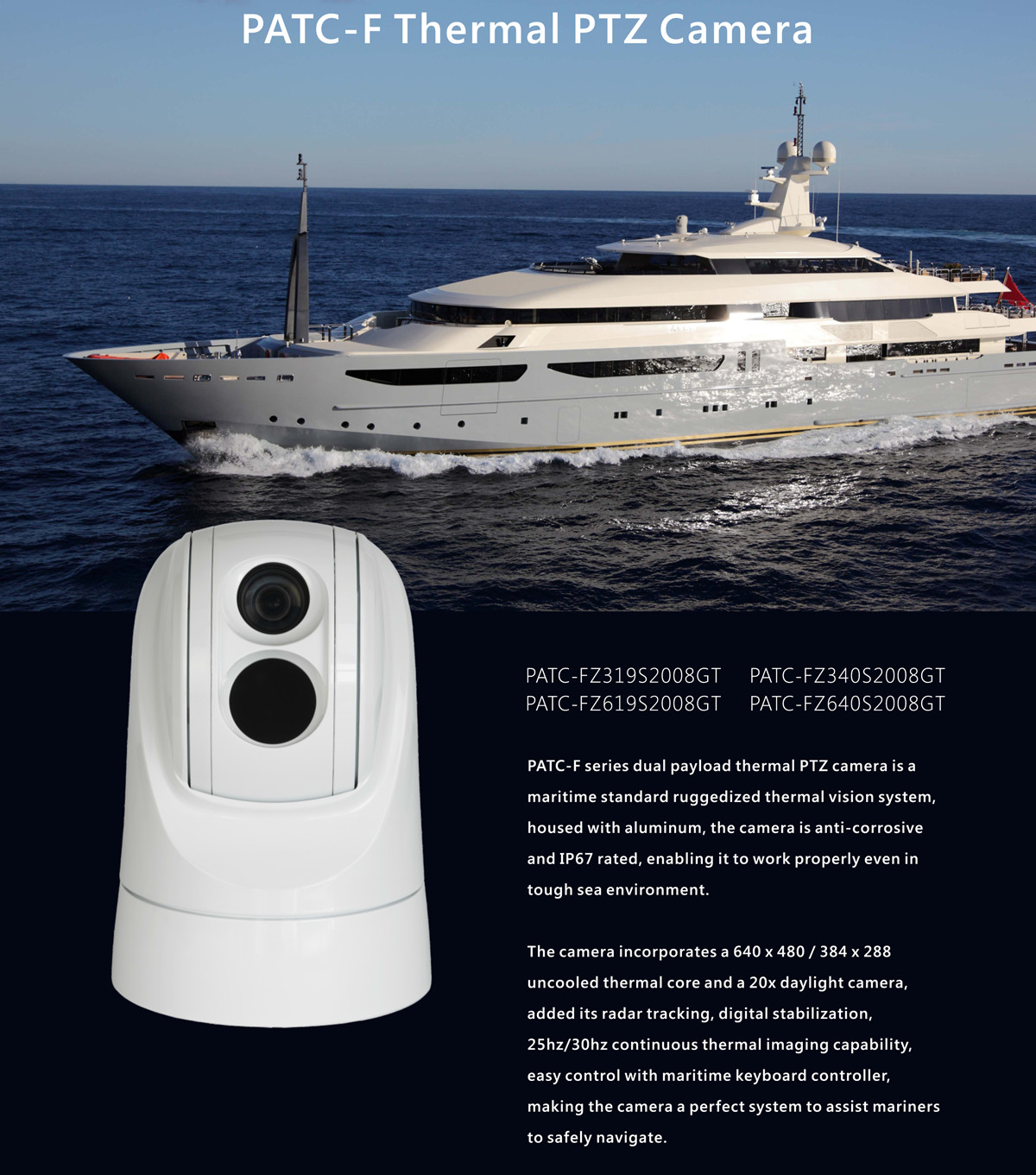
WINSAFE's maritime thermal PTZ product range includes configurations designed for long-distance monitoring. The PATC-F Series is available with 384 × 288 and 640 × 480 thermal configurations, with selected configurations supporting long detection and recognition distances for people and vehicles.
For buyers evaluating a long-range system, it is important to distinguish between detection range and recognition range. Detection means identifying that an object may be present. Recognition requires more information about what that object actually is. These are different performance levels and should be considered separately when planning a perimeter surveillance system.
For a closer look at available configurations, explore WINSAFE's thermal PTZ cameras.
PTZ Control Helps Operators Follow Moving Targets
A thermal sensor alone provides useful information, but perimeter security often involves moving targets. A person may cross a restricted area, a vehicle may approach a gate, or a vessel may move along a protected coastline.
PTZ functionality allows operators to reposition the camera without physically moving the equipment. Pan and tilt movement provide broad area coverage, while optical and digital zoom can be used when a closer view is required.
This makes a long-range thermal PTZ camera particularly useful for security control rooms. Instead of deploying a large number of fixed thermal cameras across every section of a perimeter, integrators can strategically position PTZ units at elevated or otherwise advantageous locations and use them as active surveillance points.
Preset positions can also help operators quickly return the camera to frequently monitored areas. When combined with tracking or radar information, PTZ movement can become part of a more responsive security workflow.
Thermal PTZ Cameras for Border Security
Border environments can be difficult to monitor because they often combine open terrain, roads, vegetation, hills, waterways, and remote areas. Lighting conditions can change quickly, and some areas may have limited infrastructure.
A thermal PTZ camera can provide an additional detection layer for these environments. Operators can use thermal imaging to monitor remote sections of a border and then use PTZ control to investigate areas where movement or unusual heat signatures are observed.
The technology can also be integrated with other surveillance equipment. Radar can provide information about the position of a moving target, while a camera system can provide visual or thermal confirmation. Video management software can then bring multiple surveillance sources into one monitoring workflow.
WINSAFE's PATC-F Series supports optional radar tracking and can receive radar-related information for target positioning. This type of integration is particularly relevant when a perimeter security system needs more than a standalone camera.
Perimeter Protection for Ports and Coastal Facilities
Not every perimeter is located on land. Ports, offshore facilities, coastal terminals, shipyards, and other marine installations also require long-range surveillance.
In these environments, a maritime dual PTZ camera can be particularly useful because it combines thermal and visible-light imaging in one platform. Operators can use thermal imaging for nighttime detection and low-visibility monitoring while using the optical camera when detailed visual information is needed.
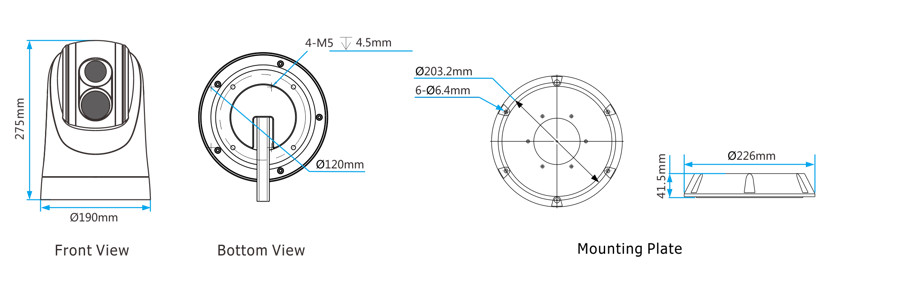
Marine installations also introduce environmental challenges. Salt spray, humidity, rain, vibration, and changing weather conditions can affect surveillance equipment. A ruggedized housing and suitable ingress protection therefore become important considerations when selecting a camera for continuous outdoor operation.
WINSAFE's maritime thermal PTZ solutions use rugged housings designed for marine environments, with selected models offering IP67 protection and stabilization features for demanding applications.
Why Dual-Sensor PTZ Systems Can Be More Practical
Thermal imaging is excellent for detecting heat contrast, but it does not always provide the same type of visual detail as a daylight camera. Conversely, an optical camera can provide useful color and shape information but may become less effective in complete darkness or poor visibility.
A dual-sensor design combines the strengths of both technologies.
For example, an operator may first notice a warm object using the thermal channel. The camera can then be directed toward the target and the optical channel used to obtain additional information. This workflow can be useful for perimeter monitoring because detection and identification do not always require the same imaging technology.
For buyers looking for a combined marine or coastal solution, WINSAFE's dual-payload PTZ camera is designed around this type of thermal and optical imaging combination.
Stabilization and Tracking for Outdoor Security
Long-range cameras are sensitive to movement. Even a small amount of vibration can become noticeable when the camera is operating at high magnification.
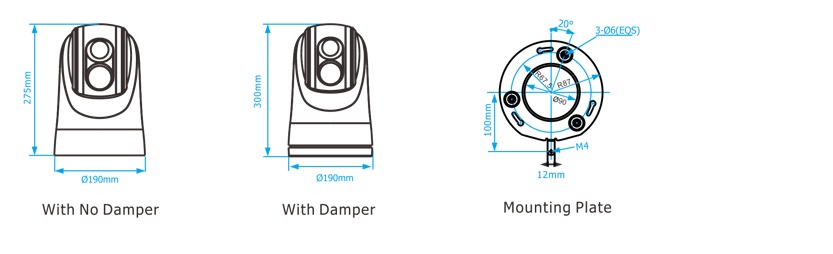
Digital or mechanical stabilization can help compensate for movement and maintain a more stable image. This is particularly important for cameras installed on towers, vehicles, vessels, or structures exposed to wind and vibration.
Tracking functions can further reduce the workload for operators. Depending on the system configuration, radar or video tracking can help direct the PTZ camera toward a target and maintain attention on a moving object.
For professional security integrators, these functions should be evaluated together rather than individually. A long-range lens is useful, but its practical value depends on whether the camera can remain stable, be controlled accurately, and work with the rest of the surveillance system.
Using a Marine Control Keyboard for Precise Operation
For surveillance systems deployed in ports, vessels, coastal security facilities, or other marine environments, camera control is another important consideration.
A marine control keyboard can give operators direct control over pan, tilt, zoom, presets, and other camera functions. This is especially useful when an operator needs to react quickly rather than navigate several software menus.
WINSAFE's maritime surveillance solutions can be configured with keyboard control for practical operation in marine environments. For professional projects, the controller interface should be considered together with camera protocols, network architecture, VMS compatibility, and the overall control-room workflow.

What Buyers Should Consider Before Ordering
Security distributors and project integrators should evaluate the application before choosing a long-range thermal PTZ camera. Several technical factors can directly influence the final system design.
- Thermal resolution: Higher thermal resolution can provide more image information, particularly when targets are small or far away.
- Lens and focal length: The lens determines field of view and influences long-range detection performance.
- Detection and recognition distance: Review both figures instead of relying only on a maximum detection specification.
- Pan and tilt range: Wide or continuous movement can be important when one camera is expected to monitor a large area.
- Stabilization: Consider stabilization when the installation point is exposed to wind, vibration, or vessel movement.
- Environmental protection: Outdoor and marine deployments require appropriate protection against water, dust, corrosion, and temperature changes.
- Control interfaces: Ethernet, RS-485, ONVIF, and other supported interfaces can affect how easily the camera integrates with an existing security system.
- Integration: Radar tracking, video tracking, VMS integration, and alarm systems may be important depending on the project.
Building a Complete Marine Thermal Imaging System
A camera is only one part of a professional surveillance solution. For marine and coastal projects, buyers may need to combine thermal cameras, optical cameras, control keyboards, displays, recording equipment, radar, navigation data, and network infrastructure.
A complete marine thermal imaging system should therefore be designed around the actual operating environment rather than based on camera specifications alone.
For example, a coastal security project may require a thermal PTZ camera positioned on a high observation tower, while a vessel may need a stabilized dual-payload camera mounted on the mast. A port facility may require multiple cameras connected to a centralized control room. Each application has different requirements for range, field of view, stabilization, control, networking, and environmental protection.
Thermal PTZ Cameras as Part of a Layered Security Strategy
Long-range thermal PTZ cameras should not be viewed as a replacement for every other security technology. Their real value comes from working alongside other systems.
A layered perimeter security architecture may include fixed visible cameras for detailed coverage, thermal PTZ cameras for long-range detection, radar for target information, access control for restricted entrances, alarms for immediate notification, and video management software for centralized monitoring.
This approach gives security teams different sources of information. When one technology is affected by darkness, distance, weather, or line-of-sight limitations, another layer can provide supporting information.
For large sites, this layered approach can also make system expansion easier. Additional cameras or sensors can be added to high-priority areas without redesigning the entire surveillance infrastructure.
Choosing the Right Long-Range Thermal PTZ Camera Supplier
For wholesale buyers and system integrators, product availability is only one part of the purchasing decision. Supplier experience, customization capability, communication interfaces, product documentation, testing support, and after-sales service can all influence the success of a project.
It is also worth discussing the intended installation environment with the manufacturer before placing a bulk order. A camera designed for a coastal security tower may require different specifications from one installed on a moving vessel. Thermal resolution, focal length, stabilization, housing protection, control method, and integration requirements should be confirmed before production.
For OEM, ODM, and project-based orders, customization may also involve thermal sensor configuration, optical zoom, mechanical structure, communication interfaces, tracking functions, and control equipment. Defining these requirements early can help buyers avoid selecting a camera that does not match the actual deployment environment.
Frequently Asked Questions About Thermal PTZ Cameras for Perimeter Security
What is a long-range thermal PTZ camera?
A long-range thermal PTZ camera combines a thermal imaging sensor with pan, tilt, and zoom functions. It is designed to monitor distant areas and detect thermal signatures while allowing operators to reposition and zoom the camera toward areas of interest.
Can thermal PTZ cameras work at night?
Yes. Thermal cameras detect infrared radiation rather than relying entirely on visible light, making thermal imaging useful for nighttime surveillance. Actual performance depends on thermal resolution, lens selection, target size, atmospheric conditions, and the required detection distance.
What is the difference between thermal detection and recognition?
Detection indicates that a potential object or target is present, while recognition provides enough image information to determine more about the target. Recognition generally requires greater image detail and is affected by target size, distance, thermal resolution, and environmental conditions.
Are thermal PTZ cameras suitable for marine applications?
Marine-specific thermal PTZ cameras can be suitable for vessels, ports, offshore facilities, and coastal security when they have appropriate environmental protection, stabilization, and control features. The required specifications depend on the mounting location and operating conditions.
Can a thermal PTZ camera integrate with radar?
Some professional thermal PTZ systems support radar integration or radar-assisted tracking. This allows radar information to help identify a target's position while the PTZ camera provides thermal or optical imaging for additional situational awareness.
Final Thoughts
Long-range thermal PTZ cameras provide security teams with an additional way to monitor large and difficult-to-protect areas, particularly when darkness or challenging visibility reduces the effectiveness of conventional surveillance.
For border security, coastal facilities, ports, remote perimeters, and marine applications, the combination of thermal imaging, PTZ control, long-range lenses, stabilization, and optional tracking can provide a flexible surveillance platform. The best configuration, however, depends on the required detection distance, target type, environment, mounting location, and integration requirements.
For distributors, security contractors, and OEM/ODM project buyers looking for thermal surveillance equipment, selecting the camera around the actual application—not simply the highest specification—can lead to a more practical and scalable system.
Explore WINSAFE's range of thermal PTZ cameras for marine surveillance, perimeter protection, and other long-range monitoring applications.



 +8613725587481
 sales@winsafecctv.com