



Dual payload thermal maritime camera adoption stands as the defining technology trend in the 2026 maritime industry. You see a single device that merges visible and thermal imaging. This design delivers all-weather, day and night situational awareness for maritime surveillance.
Why now? Stricter IMO safety regulations, falling sensor costs, and proven ROI in navigation and search-and-rescue missions converge. These factors drive the rugged thermal cameras market forward. This year marks an inflection point. Cost and performance now justify wide-scale deployment across maritime operations.
Coastal monitoring, maritime security, and general surveillance benefit from this shift. The sections ahead explore the drivers, benefits, and future outlook for coastal and offshore applications.
Key Takeaways
-
A dual payload camera combines visible and thermal imaging for clear vision day and night, even in fog or darkness.
-
New safety rules from IMO and lower sensor costs make 2026 a turning point for these cameras on ships.
-
These cameras detect heat signatures through fog and sea spray, which reduces collision risks and speeds up search and rescue.
-
They work on commercial ships, naval vessels, ports, and drones, with future AI systems that automatically spot threats.
-
Evaluate your ship's needs now. Check integration and train your crew. The safety benefits make these cameras a smart investment.
What is a Dual Payload Thermal Maritime Camera?
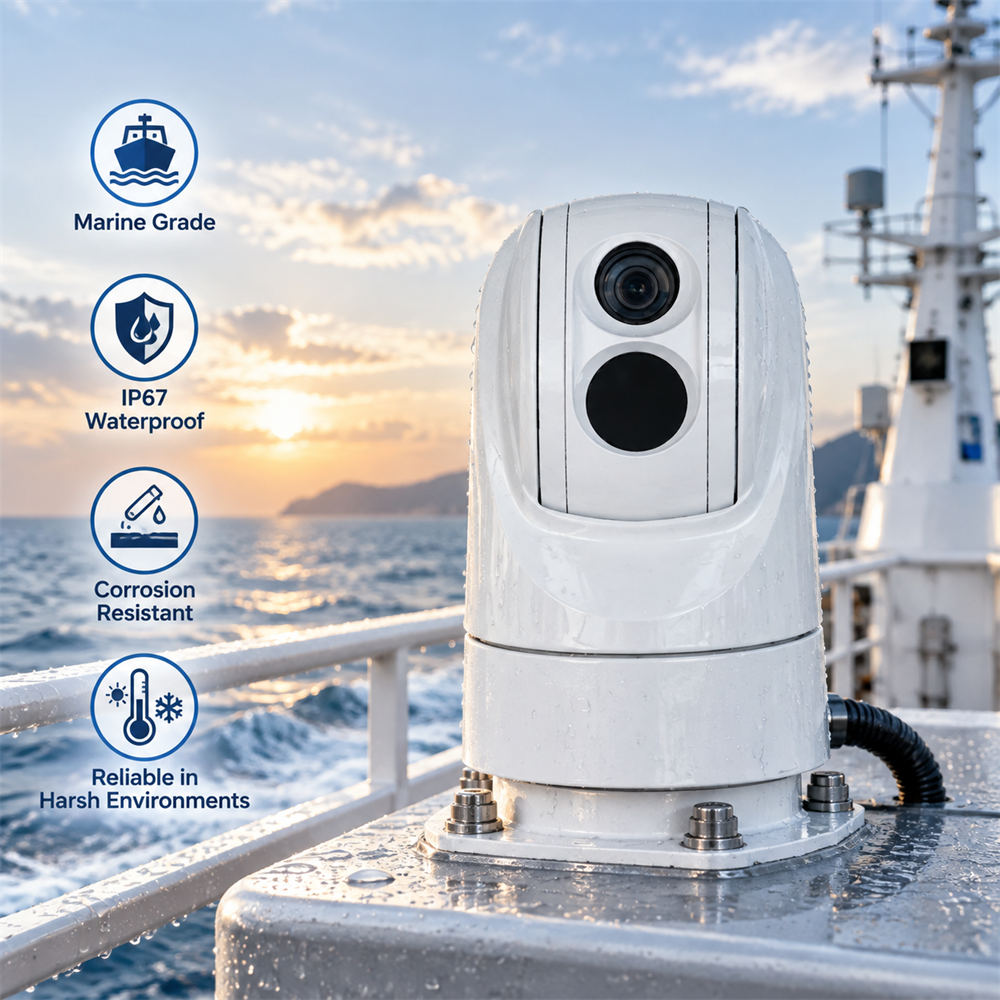
A dual payload thermal maritime camera merges two imaging systems into one rugged housing. You receive a high-resolution thermal core alongside a powerful daylight camera. The PATC F Series exemplifies this design. It pairs an uncooled thermal detector, available at 640x480 or 384x288 resolution, with a 30x optical zoom EO camera. This pairing delivers continuous situational awareness regardless of light conditions. The system detects the thermal signature of any object above absolute zero. You benefit from two perspectives in one device. The thermal channel reveals heat sources invisible to the naked eye. The EO channel provides recognizable imagery for identification and documentation. This dual approach eliminates blind spots during critical maneuvers.
Core Technology and Rugged Design
The heart of this system rests on proven thermal imaging technology. The thermal core captures heat signatures from objects at sea. It operates at 25Hz or 30Hz refresh rates for smooth video. You see a clear image even in total darkness, fog, or smoke. The simultaneous daylight feed provides color detail for identification. Advanced and/or gimbals provide comparable capabilities for smaller vessels. These systems share similar optical principles for target detection.
|
Specification |
Value |
|---|---|
|
Thermal Resolution |
640x480 or 384x288 |
|
Daylight Camera Zoom |
30x optical zoom (1/2.8" SONY Exmor R CMOS) |
|
IP Rating |
IP67 |
|
Detection Range |
Up to 5400m (vehicle), 1170m (man) |
|
Pan/Tilt Range |
360° continuous pan, -15° to 90° tilt |
|
Network Protocols |
HTTP, RTSP, TCP, UDP, ONVIF |
|
Voltage |
DC 10.8–32V |
Rugged construction defines reliability in any maritime environment. The PATC F Series uses an anti-corrosive aluminum housing. This chassis resists salt spray and continuous moisture exposure. An IP67 rating means the camera withstands heavy rain and even temporary submersion. A built-in heater and cooling fan prevent condensation and freezing in cold climates. You also get TVS 4000V surge protection. These elements ensure continuous operation on exposed decks. The pan/tilt mechanism covers 360 degrees continuously. Tilt ranges from -15 to 90 degrees. This wide coverage area captures your entire field of view from the bridge. Detection range reaches up to 5400 meters for vehicles and 1170 meters for a human-sized target.
Advanced features improve performance in rough seas. Digital stabilization compensates for vessel movement. Radar tracking reads NMEA0183 strings. The camera then automatically aims at detected targets. You get dual SDI/CVBS video outputs for flexible integration. The system supports ONVIF compliance and H.264 compression. You control the camera through Ethernet, serial, or a maritime keyboard controller. This design streamlines bridge operations and reduces crew workload.
Why 2026 is a Pivotal Year
Three factors converge to make 2026 a turning point for the rugged thermal cameras market. First, regulatory mandates from IMO and SOLAS push adoption. These organizations require enhanced situational awareness systems on commercial vessels. New IMO regulations for vessel collision avoidance drive mandatory upgrades. SOLAS requirements for search and rescue capability also push adoption. You must comply with stricter safety standards. Dual payload cameras provide a clear solution.
Second, thermal sensor costs have dropped in recent years. This reduction makes professional-grade systems accessible. Vessels that previously relied on basic radar now adopt multi-sensor suites. Radiometric infrared sensors add another layer of capability for fire detection. Traditional electro-optical cameras alone cannot match this night vision capability.
Third, interoperability with existing bridge electronics has reached maturity. These systems integrate with NMEA2000 networks, radar displays, and ECDIS. You do not need a complete bridge overhaul. The adoption curve accelerates as proven ROI emerges from early deployments.
The combination of regulatory pressure, lower costs, and proven integration drives the rugged thermal cameras market forward. Maritime operations across coastal surveillance, commercial shipping, and security applications now justify investment. The ability to detect small objects at extreme ranges changes how you approach night navigation and search operations. The rugged thermal cameras market responds with rapid innovation in the maritime segment.
Key Drivers in Rugged Thermal Cameras Market Trends
Regulatory Mandates and Safety Requirements
Regulatory pressure shapes the rugged thermal cameras market more than any other factor. The International Maritime Organization and SOLAS conventions now demand enhanced situational awareness on commercial vessels. You must comply with stricter collision avoidance and search-and-rescue standards. These rules push fleet operators toward dual payload systems.
Regulatory frameworks in major maritime regions increasingly reference thermal imaging for safety, security, and environmental protection, encouraging adoption on regulated vessels and coastal assets. Certification, data handling, and integration standards are also emerging to ensure reliable performance and interoperable thermal imaging solutions.
Government procurement adds another layer of demand. India's Ministry of Defence awarded ₹642.17 crore to Bharat Electronics for 28 EON-51 electro-optical systems with thermal imagers for naval surveillance. The U.S. Bureau of International Security requires exporters to report shipments of more than 100 thermal imaging cameras under ECCN 6A003.b.4.b to many allied countries. These rules create stricter compliance and longer delivery timelines. Supply chain diversification follows for manufacturers in the rugged thermal cameras market.
Technology Maturity and Cost Reduction
Falling sensor costs and proven performance drive the rugged thermal cameras market forward. Uncooled thermal sensors now deliver lower cost, compact size, and reduced maintenance. Leonardo DRS launched the Tenum 640 Orbit uncooled LWIR module for unmanned maritime platforms in May 2026. This launch signals broad availability of affordable infrared technology for maritime operations.
|
Metric |
Value |
|---|---|
|
Market Size in 2025 |
USD 420.00 Million |
|
Projected Market Size in 2026 |
USD 495.80 Million |
|
Projected Market Size in 2032 |
USD 815.62 Million |
|
CAGR Growth Rate (2026–2032) |
8.65% |
The rugged thermal cameras market grows at 8.65% annually from 2026 to 2032. You see this growth across recreational, fishing, commercial, law enforcement, and military segments. North America, Europe, and Asia-Pacific lead adoption. Coastal security investments and port infrastructure modernization fuel demand. The rugged thermal cameras market now supports AI-enabled processors for real-time anomaly detection. The rugged thermal cameras market benefits from this maturity. The rugged thermal cameras market also gains from predictive maintenance features. The rugged thermal cameras market reaches new buyers as prices fall. The rugged thermal cameras market trends point toward wider deployment. The rugged thermal cameras market serves surveillance needs across all vessel classes.
Benefits for Coastal Monitoring and Maritime Operations
Enhanced Situational Awareness Day and Night
You gain complete awareness of your surroundings regardless of light or weather conditions. Thermal imaging detects and tracks vessels, swimmers, and threats through fog, sea spray, and nighttime darkness. Your visible cameras fail in these conditions. The thermal channel maintains detection when nothing else works. This capability transforms how you approach coastal monitoring and maritime operations.
A dual payload thermal maritime camera merges thermal and visible-light imaging into one platform. You use the thermal channel for nighttime detection and low-visibility monitoring. When you need detailed visual information, you switch to the optical channel for color and shape confirmation. This detection-then-identification workflow proves invaluable for perimeter monitoring. The two tasks do not always require the same imaging technology.
Consider the operational advantages for your maritime security posture. Thermal imaging penetrates sea spray and low visibility. You locate survivors quickly during nighttime search and rescue operations. Long-range detection supports coordinated rescue efforts. High-resolution thermal cores at 640x480 or 384x288 deliver crisp images for object and threat identification. Gyrostabilized technology provides stable imaging in rough seas. Hermetic sealing protects against harsh marine elements. Long-wave infrared systems withstand corrosive environments and temperature fluctuations.
The table below shows how dual-band systems with edge AI outperform single thermal channels across critical capabilities.
|
Capability |
Single Thermal Channel |
Dual-Band + Edge AI |
|---|---|---|
|
Target category recognition |
Limited |
Supported |
|
Vessel-name reading |
Not possible |
Supported via visible channel |
|
Buoy color identification |
Not possible |
Supported |
|
Evidence capture |
Limited |
Remote recording enabled |
|
Operator workload |
High |
Reduced via edge AI |
|
Response time |
Slower |
Shortened |
These advantages make dual payload systems essential payloads for ocean surveillance. Your coastal monitoring benefits from persistent thermal surveillance at harbors, channels, and offshore installations. The rugged thermal cameras market responds with systems designed for these exact demands.
Critical Role in Navigation and Search & Rescue
Navigation safety improves dramatically when you deploy dual-spectrum technology. A study by the International Maritime Organization found that timely detection reduces response times by up to 50%. This directly improves search-and-rescue outcomes and collision avoidance. Industry reports indicate that dual-spectrum technology reduces maritime incidents by up to 30%. You lower collision risk substantially.
Thermal PTZ cameras detect small heat changes against cold ocean water. This enables early hazard identification and rapid course correction. Radar integration provides real-time tracking of moving targets. Your camera automatically aims at detected targets through NMEA0183 strings. Digital stabilization compensates for vessel movement in rough seas. You maintain clear images when conditions deteriorate.
The detection-then-identification workflow supports your maritime operations effectively. You first spot a warm object on the thermal channel. Then you direct the camera to the target. Finally, you use the optical channel to gather identifying information. This process works for perimeter monitoring, navigation, and surveillance alike.
For coastal monitoring and maritime operations, these capabilities prove transformative. You reduce collision risk, improve SAR response time, and enhance port security. The thermal signature of any object above absolute zero becomes visible to your crew. Your nighttime search and rescue operations gain speed and accuracy. Coastal monitoring stations detect intrusions earlier. Maritime security forces respond faster. The technology delivers measurable returns across every mission profile.
Real-World Applications and Case Examples
Commercial Shipping and Port Security
You see dual payload thermal maritime camera systems transform daily commercial shipping operations. A container vessel approaching a busy harbor uses the thermal channel to spot small craft, drifting debris, and unlit buoys. The daylight channel then identifies vessel names and markings. Port authorities deploy these cameras along breakwaters and terminal perimeters. The thermal sensor detects intruders in total darkness. Your security team responds before a threat reaches restricted zones. The rugged thermal cameras market now supplies systems that integrate with existing port radar and VTS networks. You gain persistent surveillance across channels, anchorages, and offshore installations.
Consider a real scenario. A tanker transits a narrow strait at night. Fog reduces visibility to near zero. The thermal channel reveals a fishing vessel crossing the tanker's path. Radar tracking automatically aims the camera at the target. You confirm the vessel type on the daylight feed. The bridge crew alters course in time. This workflow reduces collision risk and supports maritime security patrols. Ports also use thermal imaging to monitor cargo handling and detect unauthorized access. The technology pays for itself through fewer incidents and lower insurance premiums.
Naval Patrol and Coast Guard Missions
Naval and coast guard crews rely on infrared imaging for missions that demand absolute discretion. You patrol territorial waters under radio silence. The thermal channel detects small, fast-moving threats without emitting any light. Drug interdiction operations benefit from this covert capability. Your vessel tracks a suspect boat through darkness and sea spray. The camera maintains a clear image through digital stabilization. You gather evidence for prosecution using the daylight channel.
Search and rescue missions demonstrate the greatest value. A person in the water emits a heat signature that no visible camera can detect at night. The thermal sensor locates the survivor within minutes. You direct the rescue team to the exact position. Military defense and naval applications also use these systems for force protection. A frigate anchored in a foreign port monitors approaching craft. The camera classifies each contact as friendly or unknown. Coastal surveillance stations share thermal video across a secure network. This capability extends your awareness far beyond the horizon. The same technology supports maritime operations for customs, fisheries enforcement, and border security.
Challenges and Adoption Considerations
Integration Complexity and Compatibility
You face real hurdles when you add dual payload systems to an existing bridge. The rugged thermal cameras market offers capable hardware. Integration demands careful planning. Your vessel may use NMEA0183 or NMEA2000 networks. The PATC F Series reads NMEA0183 strings for radar tracking. You must verify that your radar and ECDIS share compatible protocols. A mismatch forces you to install protocol converters or upgrade bridge electronics. That step adds cost and downtime.
Mounting presents another constraint. Many vessels have limited deck space and crowded mast real estate. You need a clear line of sight for both the thermal and daylight channels. The camera housing must withstand vibration, salt spray, and constant motion. Power requirements also matter. The PATC F Series accepts DC 10.8–32V. You should confirm that your vessel's supply falls within that range. Multi-sensor suites often draw more current than single-payload cameras. You may need to run dedicated circuits or upgrade your power distribution panel. These steps slow adoption on older vessels with legacy wiring.
Crew Training and Operational Confidence
Your crew must learn to read thermal imagery correctly. A warm object appears bright against a cold background. That rule seems simple. Real conditions complicate the picture. Sea spray, exhaust stacks, and sun-heated surfaces create false returns. You need training to tell a genuine vessel signature from a thermal artifact. The infrared channel also behaves differently from visible light. Shadows do not exist in the same way. Your operators must build new visual habits.
Automatic tracking features require trust. Radar tracking aims the camera at a target without human input. Some crews hesitate to rely on automation. You should run supervised drills. Let operators confirm each track on the daylight channel. Over time, confidence grows. A maritime keyboard controller simplifies pan, tilt, and zoom adjustments. Hands-on practice with that controller speeds adoption. Without proper training, your crew may ignore the thermal channel entirely. That outcome wastes your investment and leaves safety gains unrealized.
Future Outlook: Drones, AI, and Beyond
Fixed Wing Drones for Coastal Monitoring and Maritime
You will see fixed wing drones for coastal monitoring and maritime transform how you watch the sea. These platforms carry advanced EO/IR sensors, high-resolution cameras, and radar systems. Fixed wing drones for coastal monitoring and maritime deliver comprehensive situational awareness across vast areas. A long endurance vtol drone extends your reach further. A fixed wing vtol drone combines vertical takeoff with long-range flight. Fixed wing drones for coastal monitoring and maritime now serve as essential payloads for ocean surveillance.
Consider how these aircraft support your missions. Fixed wing drones for coastal monitoring and maritime use AIS receivers to cross-check vessel transponder data against visual profiles. This capability flags smuggling or piracy threats instantly. Synthetic aperture radar penetrates sea fog, heavy rain, and darkness. Platforms like the JOUAV CW-25E perform daytime photogrammetry of eroding coastlines. The same aircraft switch to thermal surveillance at night for covert anti-smuggling operations. Fixed wing drones for coastal monitoring and maritime give you this dual-purpose capability in one airframe.
AI-Enhanced Analytics and Autonomous Systems
You gain real-time threat identification through AI-driven analytics. Coastal surveillance drones integrate pattern recognition to detect illegal trafficking and suspicious activities. AI embedded onboard enables real-time object detection, target tracking, and threat classification. This reduces latency for time-critical maritime missions. Sensor fusion combines thermal, hyperspectral, LiDAR, and EO/IR sensors into a single unit. Modular payload architecture allows rapid interchangeability between thermal and radar payloads.
Machine vision technology continuously identifies and follows objects on the water. Deep learning capabilities recognize debris, rafts, buoys, non-AIS boats, and persons overboard. A proprietary annotated database of over 9 million marine objects trains and improves recognition. Real-time stream processing enables immediate detection onboard. Target tracking locks onto a chosen object and keeps it centered automatically. Collision avoidance scans the environment and alerts you immediately. Perimeter surveillance rotates the camera and notifies you on intrusion. Sea.AI builds machine-vision camera systems for recreational and commercial vessels. Their Sentry system provides 360° awareness, target tracking, and collision-avoidance alarms. These systems bridge gaps left by radar and AIS. You will see autonomous naval and coastal surveillance expand rapidly.
The 2026 adoption of the dual payload thermal maritime camera reflects three forces. Regulatory pressure, proven cost-benefit, and technology readiness drive this shift. You gain 24/7 situational awareness and improved safety. Applications now span commercial shipping to drone-based coastal surveillance.
Within 3–5 years, these cameras will become standard equipment on most vessels and shore facilities. You should evaluate the ROI of thermal systems for your operations today.
FAQ
The thermal core detects vehicles up to 5400 meters and a human-sized target up to 1170 meters. This range supports early threat identification for any maritime operation.
How does the camera identify heat signatures in total darkness?
The uncooled infrared sensor captures temperature differences from any object above absolute zero. You see a clear image even without ambient light.
What role does this camera play in port surveillance?
The system monitors perimeters continuously, detecting intruders and small craft. Radar tracking automatically aims the camera at suspicious targets for immediate assessment.
Can the camera withstand harsh marine conditions?
The IP67-rated housing resists salt spray and temporary submersion. A heater and cooling fan prevent condensation. Digital stabilization maintains clear video in rough seas.



 +8613725587481
 sales@winsafecctv.com